


Over 700,000+ overseas students studied in the UK in 2023/24 (second-highest ever), so competition and admissions processes are active — this makes checking CAS and waiver policies extra important.
Many UK universities now offer routes to admit students without IELTS (internal tests, MOI, pre-sessional), with guides showing 100+ institutions offering some form of waiver or alternative pathway — but policies vary by course and faculty. Always confirm the exact course policy.Genius study abraod
Read More : UK Student Visa 2026 Processing Time, Documents & Success Tips
5 Ways to Study in UK Without IELTS
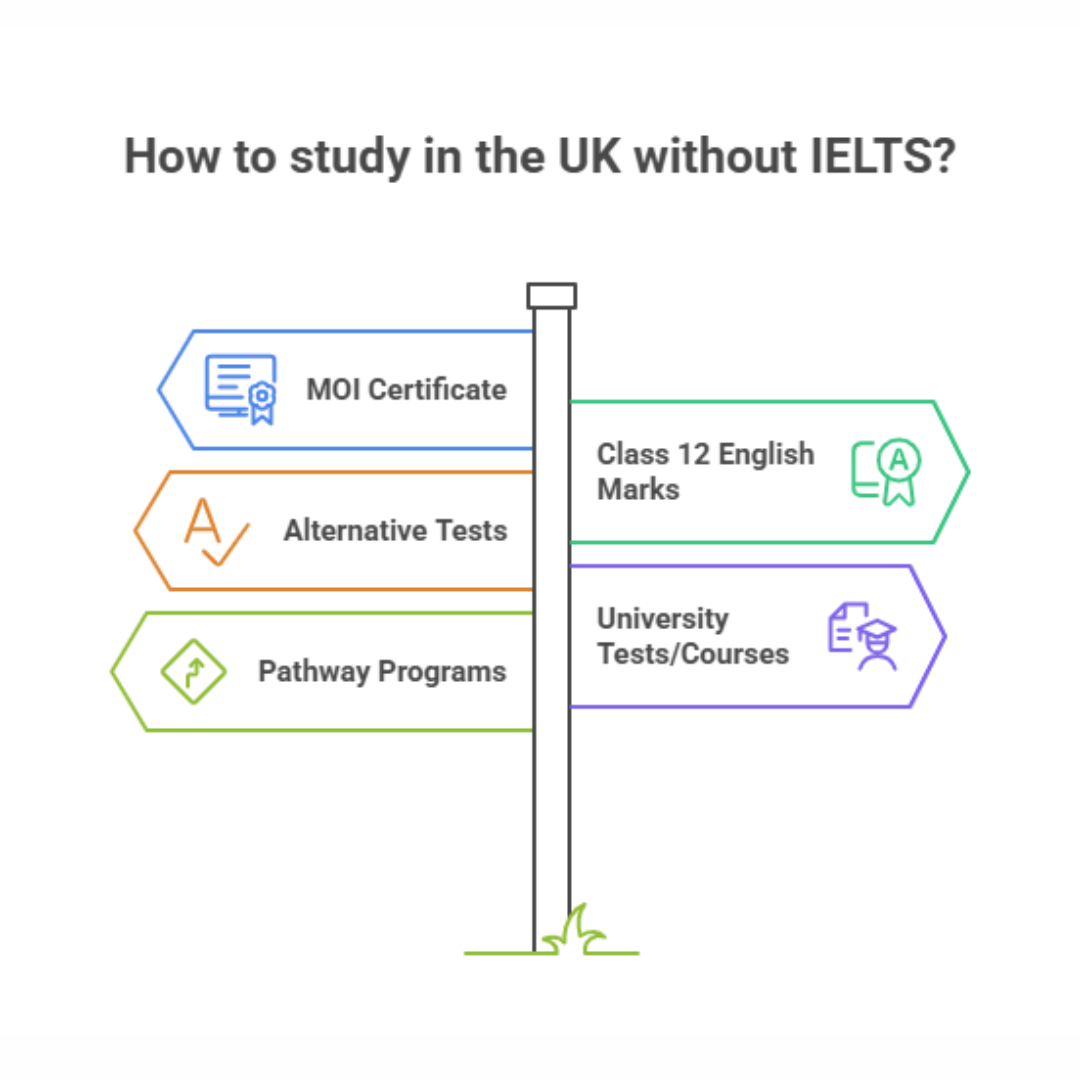
If you’re planning to study in UK without IELTS, there are multiple alternative routes recognized by universities and the UK Home Office. Here are five proven options students can use to meet English language requirements while securing admission — especially helpful for 2026 intakes.
1. Medium of Instruction (MOI) Certificate
If your previous education was conducted entirely in English, many UK universities accept a Medium of Instruction (MOI) certificate instead of IELTS.
- How it works: Your school or university issues a letter stating that English was the primary language of instruction.
- Example: The University of Portsmouth, London South Bank University, and the University of Essex accept MOI as proof of English for eligible applicants.
- Pro tip: Ensure the certificate is on official letterhead and signed by the head or registrar.
2. Class 12 English Marks / Board Certificate
Several UK universities consider your Class 12 English score from recognized Indian boards (CBSE, ISC, State Boards) as sufficient proof of proficiency.
- Eligibility benchmark: Most universities accept 70–80% or higher in English.
- Examples: Aston University, Swansea University, and the University of Bristol have accepted students based on board results.
- This route is one of the easiest ways for Indian students to study in UK without IELTS.
3. Alternative English Proficiency Tests (Duolingo / PTE / TOEFL)
UK universities increasingly accept other international tests in place of IELTS.
- Popular alternatives: Duolingo English Test, PTE Academic, TOEFL iBT.
- Advantages: These tests can be taken online from home and are often cheaper and faster.
- Example: University of Glasgow and the University of Leeds both accept Duolingo and PTE scores for admission.
4. University-Run English Tests or Pre-Sessional English Courses
Many UK institutions conduct internal English tests or online interviews to evaluate your language skills directly.
- How it works: You take a short online assessment after applying. If you pass, IELTS isn’t required.
- Alternatively, you can join a pre-sessional English course (4–12 weeks) before your main program.
- Example: The University of Sussex and Coventry University offer pre-sessional pathways that guarantee entry upon completion.
5. Pathway or Foundation Programs (English Included)
If you don’t meet direct entry requirements, enrolling in a foundation or pathway course is another way to study in the UK without IELTS.
- These programs include intensive English training along with academic preparation.
- Upon successful completion, you progress directly to your degree course.
- Example: INTO University of Exeter and Kaplan Pathways offer guaranteed progression programs for international students.
Before applying, always confirm that your chosen method (MOI, Class 12 marks, Duolingo, etc.) is mentioned on your CAS (Confirmation of Acceptance for Studies) — this ensures your UK Student Visa won’t face language verification issues.
For expert help choosing the best route to study in UK without IELTS, reach out to Genius Study Abroad — your trusted partner for admissions, visa guidance, and pre-departure support.
Read More : Cost of Studying in UK 2026: Tuition Fees & Living Expenses
How UK Visa Rules Interact with IELTS Waivers
If you plan to study in UK without IELTS, understanding the difference between university admission policies and UK Visa & Immigration (UKVI) rules is essential.
Many students get admission without IELTS but face issues later during their visa process because their CAS (Confirmation of Acceptance for Studies) doesn’t clearly reflect the English language evidence accepted by the university.
University Admission vs. UKVI English Requirement
UK universities have the flexibility to determine how they assess a student’s English proficiency. This means they can accept alternatives to IELTS, such as:
- A Medium of Instruction (MOI) certificate stating that your previous education was conducted in English.
- Class 12 English marks from recognized boards like CBSE or ISC.
- Scores from other tests such as Duolingo, PTE, or TOEFL.
- Passing an internal English interview or pre-sessional course.
However, the UKVI requirement for a student visa is separate. The visa officer does not assess your marks or interview results directly — instead, they rely on what’s written on your CAS.
The CAS must clearly mention how the university assessed your English proficiency and confirm that you meet the B2 level (CEFR standard) required for degree-level courses.
For example, if your university admits you based on MOI, your CAS should include a line such as:
If the CAS doesn’t mention this, your visa could be refused even if you’ve already met the university’s admission criteria.
Practical Checklist for Students
Verify MOI wording: The certificate must clearly state that your previous education was entirely taught in English and should be on official letterhead with a seal or signature.
Confirm accepted tests: Double-check that your university’s alternative English proofs (Duolingo, PTE, or MOI) are valid for both admission and visa purposes.
Check CAS details: Ensure that the CAS will explicitly mention your accepted English evidence — this is the most important step for a smooth visa process.
By ensuring these details, you can confidently study in UK without IELTS without facing visa complications. For personalized help with CAS verification and visa filing, reach out to Genius Study Abroad, your trusted partner for UK admissions and visa guidance.
Read More : UK Post-Study Work Visa 2026: PSW Updates for International Students
Detailed Pathways Explained
There are several routes available for students who wish to study in UK without IELTS. Understanding how each pathway works will help you choose the right option for your admission and visa success.
1. Medium of Instruction (MOI) — What’s Accepted & How to Get It
An MOI certificate is one of the most common ways to prove English proficiency without IELTS. It confirms that your previous education — school, college, or university — was conducted entirely in English.
- Who issues it: Your last attended institution (principal, head, or registrar) provides the letter on official letterhead.
- Timeline: It usually takes 1–2 weeks to obtain from your previous institution.
- Important note: Some universities require the MOI to be notarized or accompanied by a transcript that also mentions “Medium of Instruction: English.”
- Pitfall to avoid: Ensure the certificate matches the official spelling of your name and institution — inconsistencies can delay CAS issuance or visa processing.
2. Class 12 / Previous Qualification English Marks (150–200 words)
Several UK universities accept Class 12 English scores as proof of English proficiency, especially for Indian students. This is one of the easiest methods to study in UK without IELTS, as it uses documents you already have.
Typical thresholds: Most universities require 60–70% in English for undergraduate (UG) entry and 65% or higher for postgraduate (PG) programs.
Examples:
- University of Essex and Aston University accept 70%+ in English from CBSE or ISC boards.
- University of Portsmouth may accept 60%+ from state boards for certain courses.
Requirements vary between universities — always confirm on the official university webpage or ask admissions directly.
Keep both your mark sheet and board certificate ready in scanned form, as most institutions request them for verification during CAS processing.
3. Accepted Standardised Alternatives (Duolingo, TOEFL, PTE)
If you prefer a recognized English test other than IELTS, universities in the UK now accept Duolingo, TOEFL, and PTE Academic scores.
Typical score ranges:
- Duolingo: 105–120 (equivalent to IELTS 6.0–6.5)
- PTE Academic: 58–65
- TOEFL iBT: 80–90
Why Duolingo stands out: It’s affordable, can be taken online, and delivers results in 48 hours — making it a popular choice among international students in 2026.
Example universities: The University of Leeds, University of Glasgow, and Queen’s University Belfast accept Duolingo or PTE for most courses.
Always verify if the university accepts the test for visa purposes (UKVI-approved) and ensure your CAS mentions the test name and score.
4. University Internal Test, Interview, and Pre-Sessional Courses
Many UK universities allow students to prove their English through internal tests, online interviews, or pre-sessional English courses.
- Internal assessment: After applying, the university may schedule a short online English test or interview to evaluate your speaking, reading, and comprehension skills. Passing this test often waives IELTS.
- Pre-sessional English course: If your English level is slightly below the required standard, you can join a 4–12 week pre-sessional course before your degree program.
- Cost & benefit: These courses typically cost between £1,500–£3,000, depending on duration, and successful completion guarantees admission to your main program.
- Example: Coventry University and the University of Sussex offer pre-sessional programs that lead directly to degree entry and are clearly mentioned on the CAS.
5. Pathway & Foundation Programmes (100–150 words)
Pathway and foundation programs are ideal if you don’t meet direct entry requirements or prefer to strengthen your academic and language skills before starting your main degree.
- These programs combine English training with subject modules and typically last 6–9 months.
- Upon completion, students progress automatically to their degree program — no separate IELTS test is required.
- Example providers: INTO, Kaplan Pathways, and Navitas partner with UK universities like Exeter, Glasgow, and Birmingham City.
- Visa advantage: Since English proficiency is covered within the pathway, your CAS will reflect compliance with UKVI’s language rules, ensuring a smoother visa process.
For expert help choosing the right route to study in UK without IELTS, connect with Genius Study Abroad — your trusted guide for admissions, CAS support, and visa documentation.
Read More : Study in UK 2026: Best Universities, Courses & Fees
Top Universities & Colleges That Commonly Offer IELTS Waivers
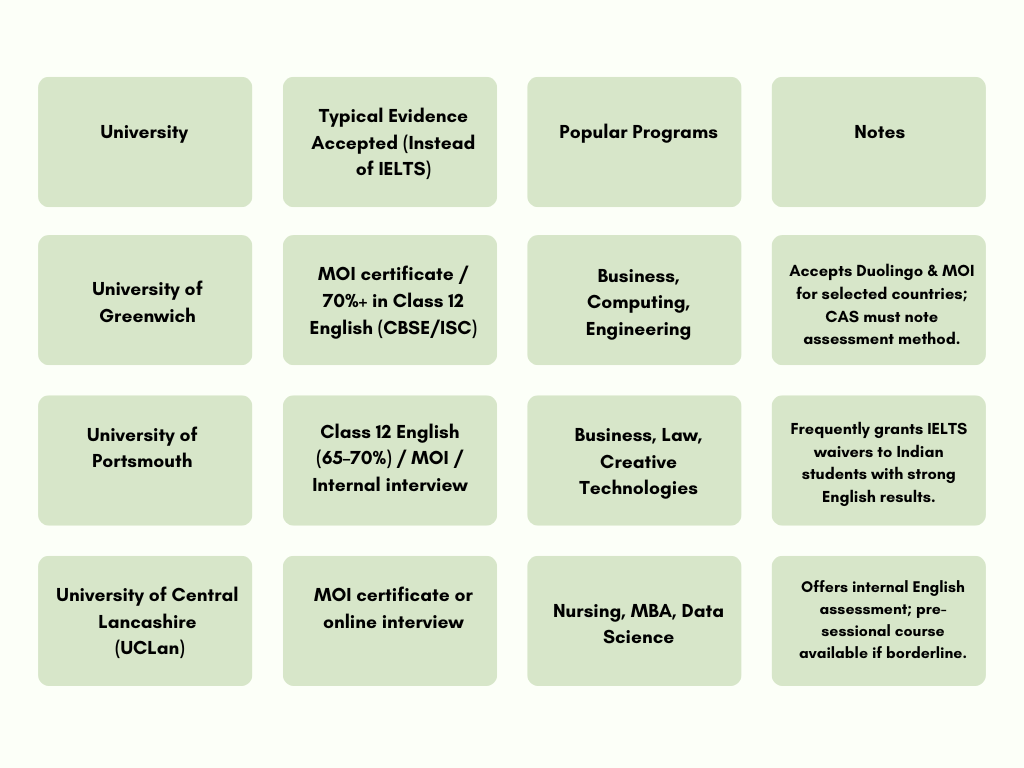
Many reputed UK universities allow students to study in UK without IELTS by accepting alternative English proficiency proofs such as MOI certificates, Class 12 English marks, or internal assessments. These waivers are particularly helpful for Indian students who have studied in English-medium schools or previously earned degrees in English.
However, it’s important to note that IELTS waiver policies vary by course and faculty, and universities frequently update their requirements. Always verify details on the official university website or consult their international admissions team before applying.
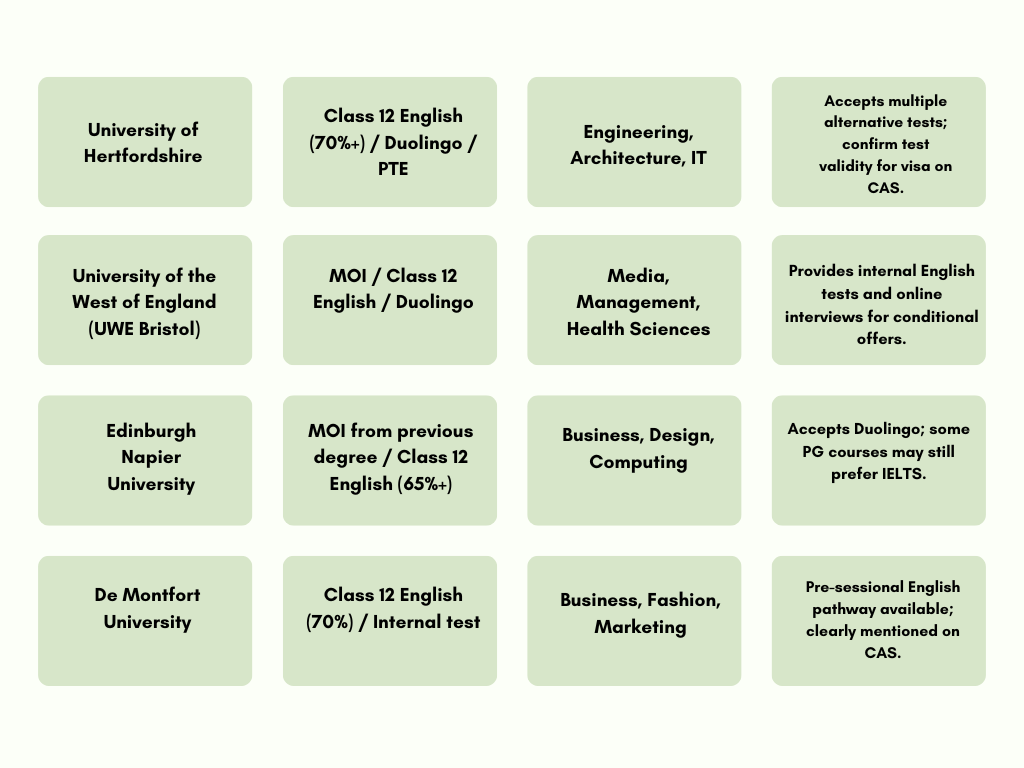
Key Takeaways
- Most universities now recognize multiple alternatives to IELTS — especially MOI, Class 12 English, and Duolingo.
- The CAS (Confirmation of Acceptance for Studies) must clearly mention the accepted proof of English proficiency.
- Always verify program-specific rules, as waiver acceptance can differ between undergraduate, postgraduate, and research programs.
For personalized guidance on applying to these universities and ensuring your visa process aligns with UKVI requirements, contact Genius Study Abroad — your trusted expert for admissions, CAS, and study in UK support.
Read More : UK Intakes 2026 Explained: January, May & September Admissions
Course-by-Course Checklist & Eligibility (UG vs PG)
When you plan to study in UK without IELTS, your eligibility depends not just on your English evidence but also on your academic background and supporting documents. Here’s a breakdown of what’s required for Undergraduate (UG) and Postgraduate (PG) admissions in 2026 — along with a practical checklist to help you prepare.
Undergraduate (UG) Courses
Minimum Academic Requirements:
- 60–70% overall in Class 12 from CBSE, ISC, or recognized State Boards.
- English score of 70% or above (accepted by many universities in place of IELTS).
Document Checklist:
✅ MOI (Medium of Instruction Certificate) – if your school education was in English.
✅ Class 10 & 12 Mark Sheets and Passing Certificates – for verification.
✅ Passport Copy – valid for at least 6 months after course start date.
✅ English Evidence – MOI, Class 12 marks, or alternative test (Duolingo, PTE, TOEFL).
✅ Statement of Purpose (SOP) – explaining your academic goals and reasons for studying in the UK.
✅ One Reference Letter – preferably from a school teacher or counselor.
Additional Tips:
- Some foundation or pathway programs may accept students with lower grades (50–55%) and help bridge English or academic gaps.
- If you studied in an English-medium school, ensure your MOI mentions
Postgraduate (PG) Courses
Minimum Academic Requirements:
- 55–65% or above in a relevant bachelor’s degree (equivalent to UK second-class honours).
- For competitive programs like MBA or Data Science, 60–70% may be preferred.
Document Checklist:
Bachelor’s Degree Certificate & Transcripts – official copies, stamped and signed.
MOI Certificate – from your university, confirming English as the medium of instruction.
English Evidence – Class 12 marks, MOI, or approved tests like Duolingo or PTE.
Updated CV/Resume – especially for business or management courses.
Statement of Purpose (SOP) – highlighting your career goals, academic background, and reasons for choosing the UK.
Two Reference Letters – from academic or professional sources.
When Work Experience Matters:
- For professional programs (e.g., MBA, Project Management, or Public Health), 2–3 years of relevant experience can strengthen your profile and even compensate for slightly lower academic scores.
Bridging or Pre-Master’s Courses
If your previous qualification or English level doesn’t meet the direct entry criteria, universities offer bridging (pre-master’s) or foundation programs that combine academic study and English support. Completing these ensures smooth progression to your main degree.
By following this checklist and preparing your documents early, you can confidently study in UK without IELTS while meeting all academic and visa requirements. For personalized application support, documentation review, and CAS guidance, connect with Genius Study Abroad — your trusted expert for UK university admissions.
Read More : Top Scholarships in UK for Indian Students 2026
Step-by-Step Application & Visa Timeline
Applying to study in UK without IELTS follows a structured process — from shortlisting universities that accept IELTS alternatives to finally obtaining your student visa. While timelines can vary depending on university and intake (January, May, or September), the entire process generally takes 6–12 weeks. Below is a practical step-by-step guide with realistic timeframes and key reminders.
Shortlist Universities (1–2 Weeks)
Start by identifying universities that accept English alternatives such as MOI, Class 12 English marks, Duolingo, or pre-sessional courses.
- Check official university websites or contact admissions teams to confirm their IELTS waiver policy.
- Make sure your chosen university’s waiver method (e.g., MOI) is valid for both admission and visa (CAS) purposes.
Apply & Provide English Evidence (1–2 Weeks)
Submit your online application with:
- Academic transcripts, passport, and English proof (MOI/marksheet/test results).
- A well-written Statement of Purpose (SOP) and reference letters.
If your chosen university requires an internal English test or online interview, schedule and complete it promptly.
Receive Conditional Offer & Satisfy Conditions (2–4 Weeks)
After reviewing your documents, the university sends a Conditional Offer Letter. Typical conditions include:
- Submitting final transcripts, MOI, or proof of funds.
- Paying a tuition deposit (usually £2,000–£5,000).
Once all conditions are met, you’ll receive an Unconditional Offer — a key step before CAS issuance.
CAS Issuance & Visa Application (2–4 Weeks)
- The university issues your Confirmation of Acceptance for Studies (CAS), which officially records your English proficiency evidence (e.g., MOI, Duolingo, pre-sessional completion).
- You can then apply for your UK Student Visa (Tier 4) online via the UKVI portal.
- Prepare your financial documents, CAS letter, passport, academic certificates, and tuberculosis test report (if required).
Typical visa processing time: 15–21 working days (standard) or 5 working days (priority service).
Sample 8–10 Week Timeline
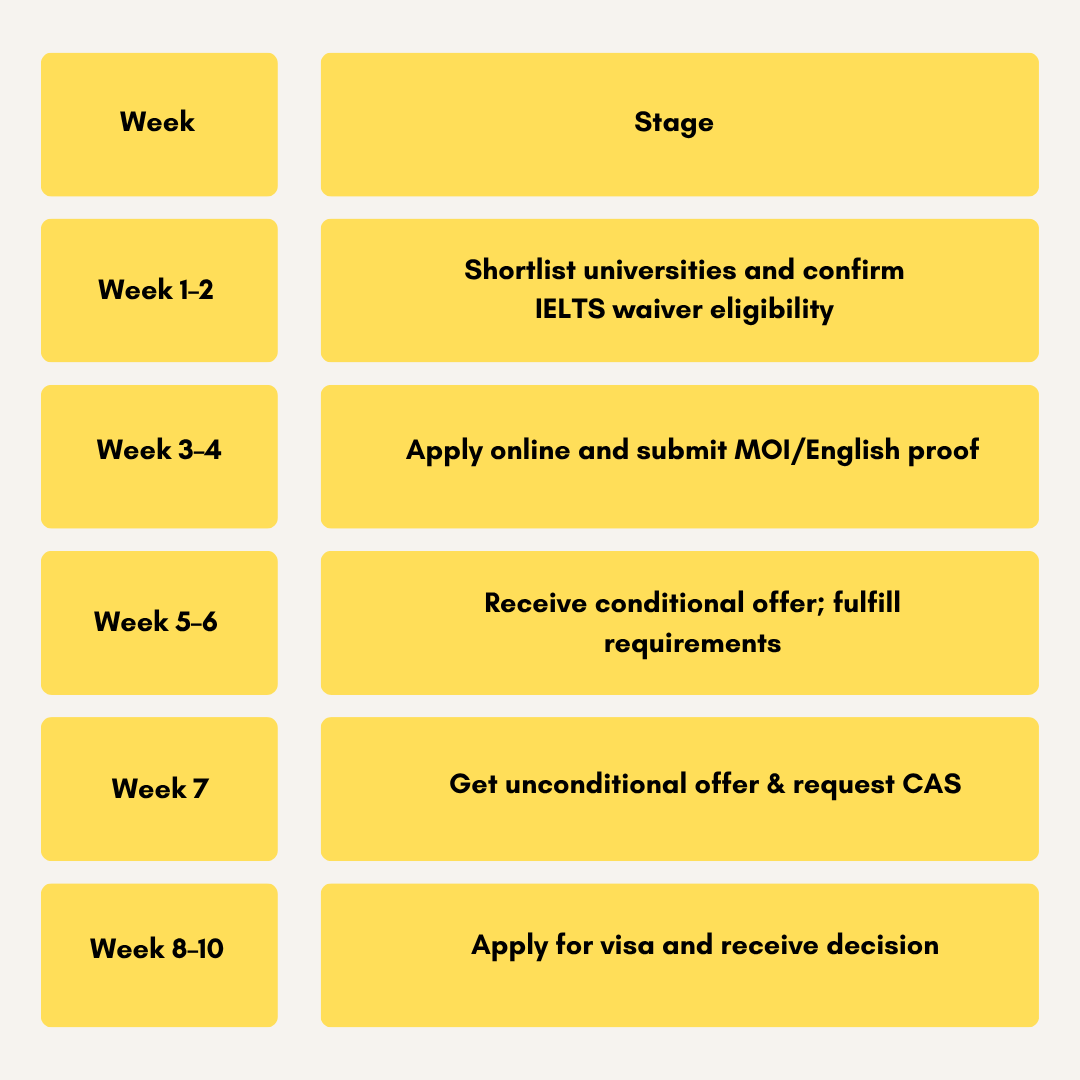
Begin your application process at least 3–4 months before your course start date to avoid last-minute visa delays.
For expert help with university selection, CAS documentation, and visa filing, reach out to Genius Study Abroad — your trusted partner for a smooth journey to study in UK without IELTS.
Read More : UK Student Visa fee 2026: Latest Rules, Requirements & Application Guide
Cost Comparison: IELTS vs Alternatives & Pre-sessional Costs
When planning to study in the UK, understanding the financial and time costs of different English proficiency options is essential. While IELTS has traditionally been the standard, many students are now opting for Duolingo, PTE, TOEFL, or even pre-sessional English courses depending on their circumstances and university preferences.
1. IELTS Test Costs
- Average Fee: ₹17,000–₹18,500 (approx. £160–£180)
- Validity: 2 years
- Result Time: 13 days (computer-based: 3–5 days)
- Opportunity Cost: Requires formal test booking and preparation, which can delay applications if not planned early.
IELTS remains widely accepted by both universities and UKVI for visa purposes.
2. Duolingo English Test
- Average Fee: ₹6,500 (approx. $59)
- Validity: 2 years
- Result Time: 48 hours
- Opportunity Cost: Can be taken online from home anytime, saving time and money.
Increasingly accepted by UK universities for admission purposes but not valid for UKVI visa applications, so the CAS must reflect university-level acceptance.
3. PTE & TOEFL
- PTE Fee: ₹15,900–₹17,000
- TOEFL Fee: ₹16,000–₹17,500
- Validity: 2 years
- Result Time: 2–5 days (PTE) / 6–10 days (TOEFL)
Both are accepted by many UK institutions and, in some cases, by UKVI for specific test centers (especially PTE Academic UKVI).
4. Pre-sessional English Courses
- Duration: 6–12 weeks
- Average Cost: £2,000–£4,000
- Purpose: For students who don’t meet direct English entry criteria. Successful completion allows progression to the main degree.
- Opportunity Cost: Higher upfront cost and longer duration but can improve English proficiency and academic readiness.
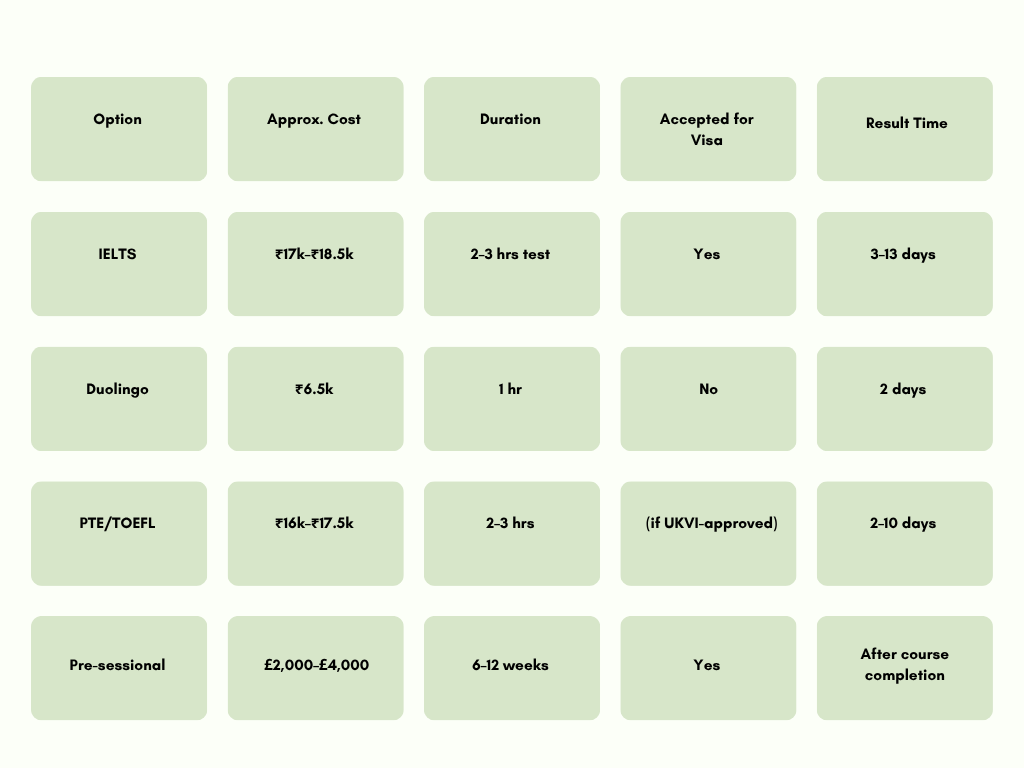
Always check your target university’s English requirements and CAS policy. Choosing the right option can save both money and months of waiting time.
Read More : 1-Year Master in UK for International Students 2025
Conclusion
Studying in the UK without IELTS in 2026 is absolutely possible — provided you understand how universities and UKVI handle English language requirements differently. Many universities now accept Medium of Instruction (MOI) letters, Class 12 English marks, or alternatives like Duolingo, PTE, and TOEFL in place of IELTS. However, the key is ensuring that the same accepted proof is reflected in your CAS (Confirmation of Acceptance for Studies) to meet UK visa rules.
Students should begin early — shortlist universities, confirm acceptable English evidence, and get documentation ready (MOI wording, transcripts, and references). If you don’t meet the criteria directly, options like pre-sessional courses or pathway programs can still lead you to your chosen degree.
Each university has its own rules, so it’s crucial to check the latest admission criteria and visa updates before applying. Policies change frequently, and a small documentation gap can delay your CAS or visa approval.
Ready to plan your UK journey?
Get personalised guidance on universities that accept IELTS waivers and ensure your application and visa process run smoothly.
Contact our study abroad counsellors today or fill out the enquiry form to get started with your UK application for 2026 intake.
Contact No : 70 335 335 70
📩 Get expert help now and secure your UK admission without IELTS!, Genius study abraod
FAQs
1. Can I get a UK student visa without IELTS in 2026?
Yes, you can study in the UK without IELTS in 2026, as long as your chosen university confirms your English proficiency through an alternative method (like an MOI certificate or English marks). The UKVI accepts these alternatives if they are clearly mentioned in your CAS (Confirmation of Acceptance for Studies) issued by the university.
2.Which UK universities accept MOI instead of IELTS?
Many reputed institutions such as the University of Portsmouth, University of Hertfordshire, UCLan, and De Montfort University accept a Medium of Instruction (MOI) certificate if your previous education was entirely in English. Always verify university-specific requirements on their official website, as policies may change each year.
3. Is Duolingo accepted for CAS?
Some UK universities accept Duolingo English Test scores as an alternative to IELTS, but not all. If a university issues your CAS using Duolingo as English evidence, you can apply for a visa with it. It’s best to confirm directly with admissions before applying.
4. Will skipping IELTS affect my scholarship chances?
Not necessarily. Many scholarships are merit-based or program-specific, focusing more on academic performance than IELTS scores. However, some global or government-funded scholarships still list IELTS as a preferred test. Always review eligibility criteria carefully before applying.
5. Can pre-sessional completion be included in CAS?
Yes. Once you complete a university-run pre-sessional English course, your university can update your CAS to show you have met the English requirement. This allows you to apply for a visa for your main degree course.
6. What percentage in Class 12 English is usually acceptable?
For undergraduate admissions, most universities require 60–70% in Class 12 English. For postgraduate programs, around 65% or above in English at the previous qualification level is commonly accepted.